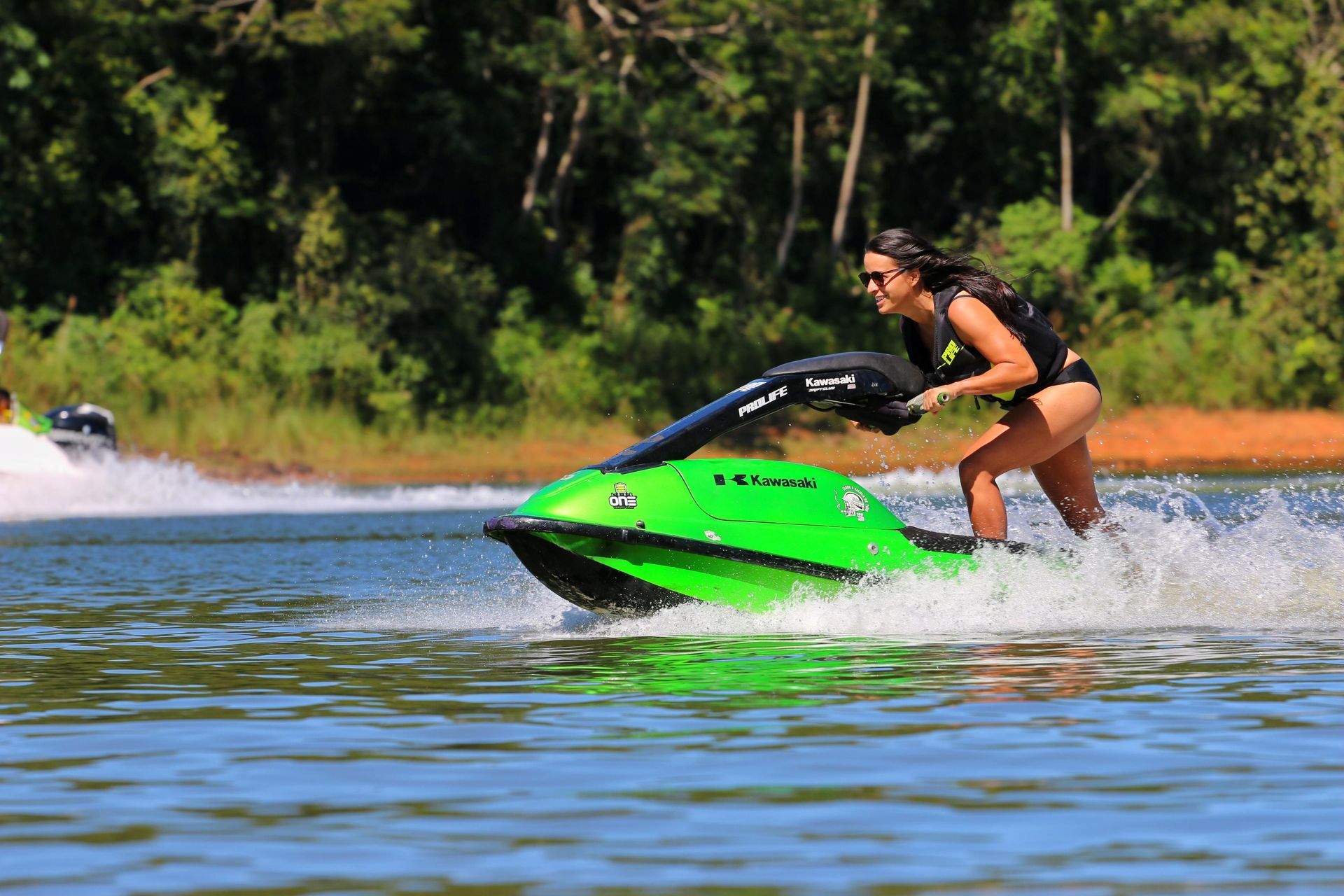
Texas does not require you to carry insurance on a personal watercraft. No state statute, no registration requirement, no proof-of-insurance sticker. You can buy a jet ski Saturday morning, register it with Texas Parks and Wildlife, and be on Eagle Mountain Lake by noon with zero coverage.
Plenty of people do exactly that. It is also one of the worst uninsured-risk trades available in Texas, and here is the arithmetic.
What Texas law actually requires
Under Texas law a personal watercraft — a Sea-Doo, WaveRunner, Jet Ski, anything you ride rather than sit inside — must be registered and titled
with Texas Parks and Wildlife. Riders born on or after September 1, 1993 must carry a boater education certificate. Everyone aboard needs a wearable life jacket, and PWC operation is restricted to daylight hours.
Insurance is nowhere on that list.
Three parties who will require it anyway
Your lender.
Finance the machine and the lender will require physical damage coverage naming them as lienholder for the life of the loan. Non-negotiable, and it is usually the reason people buy a policy at all.
Your marina or storage facility.
Most Texas marinas and dry-stack operations require proof of liability coverage — often $300,000 or more — before they will rent you a slip or a rack. Show up without it and you do not get the space.
The lake authority.
Some Corps of Engineers and municipal-authority lakes attach insurance requirements to permits and organized events. Worth checking before tournament season or a big group weekend.
The trap: your homeowners policy will not carry this
This is the single most expensive misunderstanding we see on watercraft.
A modern PWC does 60-plus miles an hour, has no brakes, and steers only under throttle. It carries up to three people, and the operator is very often a teenager or a guest who has never touched one before. If your machine — or a rider on your machine — injures somebody, you are looking at medical bills, lost wages, and potentially a lawsuit. Texas is an at-fault, tort state. There is no cap that saves you.
Homeowners liability typically covers watercraft only under narrow limits — small horsepower, short length — and personal watercraft are frequently excluded by name.
Read your policy or ask us to read it for you. Do not assume the house covers the machine, because it usually does not.
Typical PWC liability limits run $100,000 to $500,000, and moving from the bottom of that range to the top usually costs a fraction of what people guess.
The coverages worth understanding
A real watercraft policy is built from liability, hull physical damage, uninsured boater, medical payments, and on-water towing. We break down what each one actually pays for on our Texas boat and watercraft insurance coverages
page — worth reading before you compare quotes.
Two items specific to PWC that people miss entirely:
Wreckage removal and fuel-spill liability.
If your PWC sinks, you may be legally responsible for removing it and for any fuel that escapes. Those cleanup bills can dwarf the value of the machine itself.
Trailer and on-water towing are two different things.
Your auto policy's liability generally extends to a trailer you are towing, but physical damage on the trailer often does not. And roadside assistance on your car policy will not come get you when you are stranded in the middle of a lake. On-water towing is a cheap add-on that pays for itself the first time you need it.
One more that is badly under-purchased in Texas: uninsured boater coverage.
Since PWC insurance is not required here, a real share of the traffic around you on any given Saturday is carrying nothing at all. If one of them hits you, that is the only coverage that responds.
What it costs in Texas
For a typical recreational PWC — one or two machines, adult riders, garage or storage-facility kept, clean record — annual premiums commonly land in the low-to-mid hundreds. Multi-unit and multi-policy discounts move that number meaningfully.
What drives it up: horsepower and top speed, number of machines, rider age and experience, storage location, and claim history. What drives it down: boater safety course completion, bundling with your home and auto, storing under cover, and a higher physical-damage deductible if you can absorb it.
If you want a real number rather than a range, you can get a boat and watercraft insurance quote
in a few minutes.
The North Texas angle
Around here, PWC season means Eagle Mountain Lake, Lake Bridgeport, Lake Worth, Grapevine, and Lewisville — and on a July Saturday all of them are crowded. Congestion is what produces PWC claims, not open-water speed. Wake-crossing collisions, ramp-area contact, and inexperienced guest riders in tight traffic.
If your machine lives at or near the lake, the property side matters too — we write insurance for Lake Bridgeport boaters and homeowners
and know how carriers treat waterfront and near-water risk in Wise County.
Two practical notes. First, if you let friends or extended family ride, confirm how your policy treats permissive users — some restrict coverage to named operators. Second, if your machine sits on a trailer at the house nine months a year, say so; off-season storage discounts are real.
Where TAP fits
We write personal watercraft, boat, RV, ATV/UTV, and motorcycle coverage alongside the home and auto policies most of our clients already have with us — which usually means a bundle discount and one agency that sees the whole picture instead of three companies that each see a piece of it.
As an independent insurance agent in Wise County, we shop it across multiple carriers rather than selling you one company's answer.
If you bought a machine this summer, a five-minute call gets you a real number.
Call (800) 666-2254 for a free quote — or text QUOTE to (817) 646-6700 · tapinsuretx.com