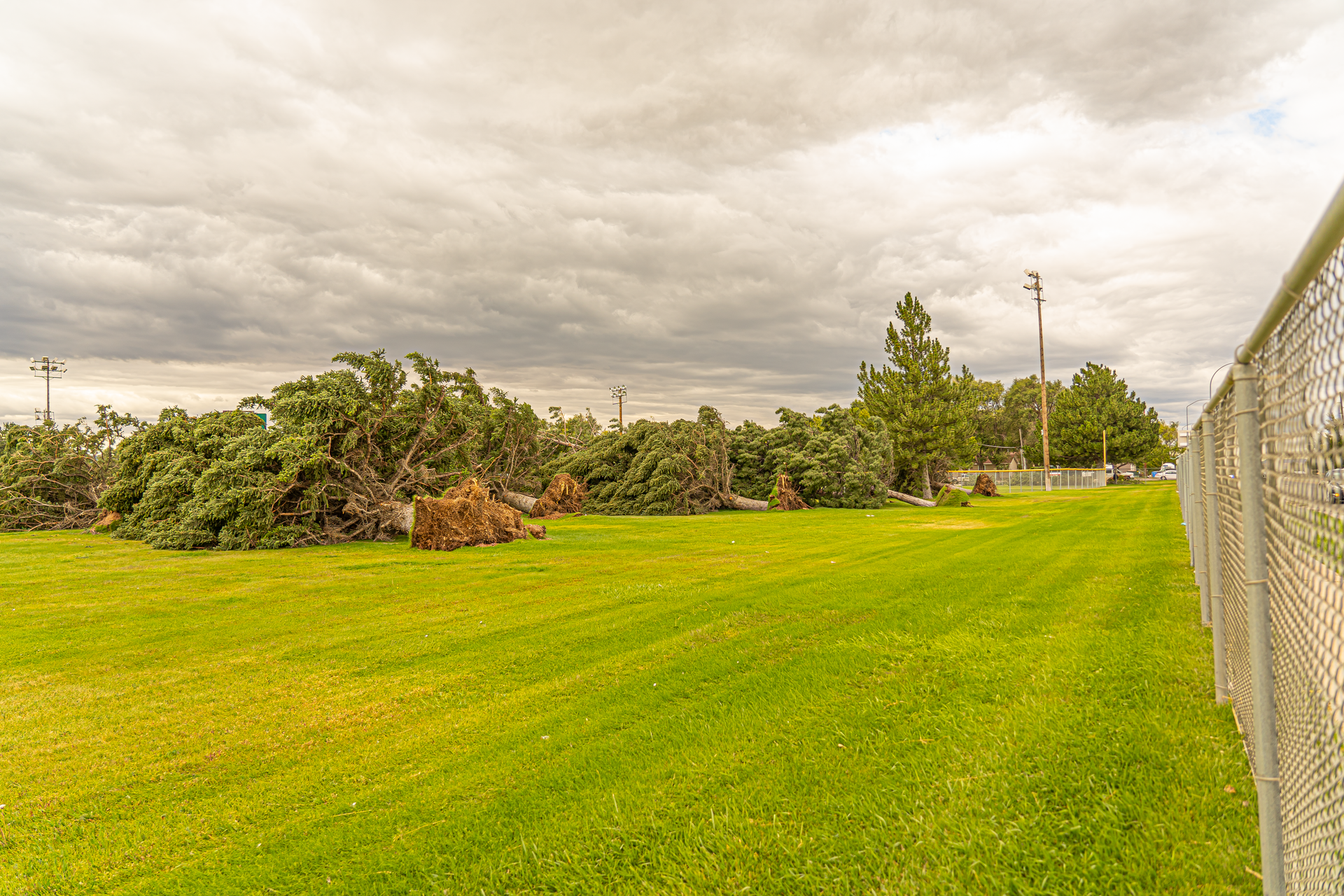
Picture a stormy October night, with a line of thunderstorms rolling east along Highway 287 near Rhome. A big old post oak on your neighbor's side of the property line gives way in the wind and lands across forty feet of your cedar privacy fence. By morning it is lying in your backyard, and you are standing there with your coffee wondering whether the bill belongs to you or to the neighbor.
Here is the short answer. When a neighbor's tree falls on your property in a storm, your own homeowners policy usually pays for the damage, no matter whose tree it was. The neighbor's policy only enters the picture when negligence can be shown, such as a dead or dying tree they knew about and left standing.
The rule that surprises everyone
Most people assume that if a tree grew on someone else's land, that someone else is responsible when it falls. Insurance generally does not work that way for a storm. A healthy tree knocked over by strong wind is treated as an act of nature, which simply means nobody did anything wrong and nobody can be blamed for it. That can feel unfair, especially when the roots are plainly on the other side of the line, but it is how most storm claims are handled.
Because no one is at fault, the claim goes to first-party coverage, which is your own policy paying for your own property where the tree happens to land. A fence typically lives under
other structures coverage, the part of a policy that handles things on your lot that are not attached to the house. The same logic applies if the tree lands on your roof or your shed, although a different section of the policy responds to each.
When the neighbor's policy does pay
Negligence is the legal word for failing to use reasonable care. If a neighbor knew a tree was dead, diseased or leaning hard toward your house and did nothing about it, a claim against their liability coverage becomes possible. Liability coverage is the part of a policy that pays when the policyholder is responsible for damaging someone else's property.
Notice is the hinge on which this turns. A tree that was obviously dying, and that the neighbor had been told about in writing, looks very different to an adjuster, the insurance company's claim investigator, than a healthy oak toppled by a straight-line wind. Even then, the neighbor's insurer will look into it before agreeing to anything, so none of this is a promise of how a particular claim will turn out.
What your policy pays for the fence
Coverage B is the section of a homeowners policy for other structures, meaning fences, detached garages, sheds and similar things that are not connected to the house. It is typically set as a percentage of the dwelling limit, which is the amount of coverage on the house itself. That means the fence has its own ceiling, and the ceiling is tied to the size of the rest of the policy.
Storm season is also when many homeowners discover
coverage gaps they did not know they had. An older fence may be paid at actual cash value, often called ACV, which is the replacement cost minus a deduction for age and wear. One plain note: who owns the fence and where the boundary actually sits are legal questions, not insurance advice, so a surveyor or attorney is the right person for those.
Debris removal has its own limit
Getting the tree off your fence is often a separate line item. Debris removal is commonly a sublimit, meaning a smaller cap tucked inside the larger policy, and it may depend on whether the tree actually hit a covered structure. When a tree damages part of a fence or a roof, hauling it away is more likely to be treated as part of the claim.
A tree that falls in your yard and hits nothing is often not covered at all, and that surprises a lot of people. The policy is built to repair damaged property, so a fallen tree with no damaged property attached tends to be treated as ordinary yard cleanup. That can be a hard thing to hear when a huge trunk is blocking the back gate. It is worth asking how your policy handles this before a storm instead of after one.
The wind deductible question
A deductible is the portion of a covered loss that you pay before the insurance company pays anything. In North Texas, wind and hail deductibles are usually percentage-based rather than a flat amount, and that percentage can apply to storm tree claims. You can find yours on the declarations page, the summary page at the front of your policy.
Here is how the math works without any numbers. Take the dwelling limit, multiply it by the deductible percentage, and the result is what you absorb on a wind claim. A modest fence repair can land below that amount, which means the claim might pay nothing, and that is why some people handle a small repair out of pocket. It is a good reason to know your percentage ahead of time rather than learning it in the middle of a claim.
Document the tree before the next storm
The difference between a storm claim and a negligence claim often comes down to what you can prove later. If a neighbor's tree looks dead or leaning, a little paperwork today can turn "it was just a storm" into a documented problem. Three simple moves cover most of it.
Photograph it. Take dated photos of the dead limbs, bare branches, fungus or lean from your side of the property line. Repeat them every few months so the record shows the tree getting worse.
Put it in writing. Send a dated certified letter describing the tree and asking the neighbor to take a look at it. Prior written notice is often the thing that separates a tree someone knew about from a genuine surprise.
Get an opinion. A short note from a certified arborist, a professional tree specialist, saying the tree is dead or unsound carries real weight. Keep a copy with your photos and your letter, and store them somewhere you can find them after a storm, such as a folder in your email.
If you are wondering how the fence, the deductible and the debris limit would all play out on your place, we are glad to talk it through and look at how your homeowners coverage
is set up. There is no pressure at all, and it is simply a chance to ask questions before storm season rather than after it.
TAP Insurance Agency is an independent agency that shops multiple carriers, so we can compare options instead of pointing you at just one company. Whatever the next storm brings, a little preparation goes a long way toward making a hard morning easier.
Call (800) 666-2254 — or text
QUOTE to
(817) 646-6700 · tapinsuretx.com
Educational only; coverages and availability vary by carrier. TAP Insurance Agency, PLLC — Rhome, TX, licensed in Texas and Oklahoma.